
A four-legged robot has solved a giant Rubik's Cube using nothing but its feet. It's an ANYmal-D, it has no arms or hands, and it was trained at the Robotic Systems Lab at ETH Zurich in Switzerland. The cube is 40 centimetres on each side and weighs 4.6 kilos. The robot solved it three times out of three, unaided, taking 8 or 9 minutes each time. The team posted the paper on arXiv on 17 October 2026.
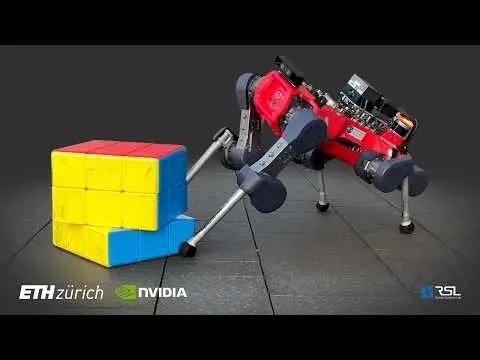
Fast it isn't. The Purdue University robot that holds the Guinness record solves a normal cube in 0.103 seconds. The hard part here is something else: moving the cube with the same legs it needs to stay upright.
How it works
First it looks. It walks around the cube with its cameras, tips it over to see the bottom face and reads the colour of every square. From that, one program (Kociemba's algorithm) works out the solution and another turns it into actions the robot knows how to do. That comes to about 30 steps.
It can only do four things with the cube: tip it forwards, tip it backwards and turn it one way or the other. To turn it, the robot holds the bottom layer with its right leg and moves the other two with its left. If a different face needs turning, it repositions itself and tips the cube until that face is on the bottom.
It learned in a simulator
Nobody programmed each movement. It learned by reinforcement, practising in a simulator, and what it learned was then moved to the real robot, which steers by its cameras and the position of its joints. It never even learned the clockwise turn: that's the other one, mirrored.
It doesn't always work
In tests of single movements, the tips worked 15 times out of 15. The turns failed more often: 13 out of 15 anticlockwise and 10 out of 15 clockwise, nearly always because it turned too far. Outdoors it also had more trouble seeing the cube, finishing 3 of 5 scans, against 5 of 5 indoors. And three solves are too few to call the robot reliable. This is a demonstration.
What it's for
The cube isn't the point. The authors want legged robots that can do jobs with their feet without needing a robotic arm, like holding a toolbox still with one leg while closing the lid with the other, or folding up a crate.
You have the advantage: two hands and a normal cube. If you want to learn, here's the step-by-step Rubik's Cube solution. And if you're stuck, our Rubik's Cube solver reads your cube with your phone camera and tells you which moves to make.