
In March 2014, a robot made of Lego pieces solved the Rubik's Cube in 3.253 seconds. It was faster than any person: the human record back then was 5.55 seconds. Eleven years later, the robot record stands at 0.103 seconds, less than the blink of an eye. This is the story of how we got there.
CubeStormer 3: the Lego robot
CubeStormer 3 was built by British engineers David Gilday and Mike Dobson in their spare time, over 18 months. It was made of Lego Mindstorms pieces and its "brain" was a Samsung Galaxy S4 phone: the phone's camera photographed the cube, an app worked out the solution and the robot carried it out with four arms.
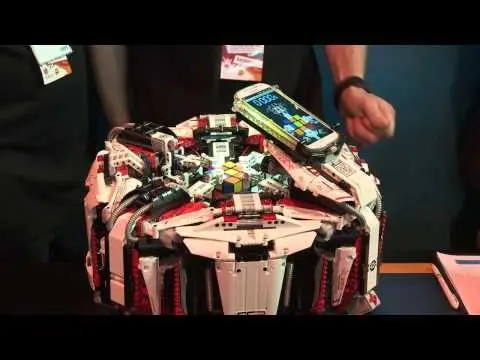
It set the record on 15 March 2014 at the Big Bang Fair in Birmingham (UK), in front of a Guinness World Records adjudicator. The previous record, 5.27 seconds, belonged to its predecessor, CubeStormer 2.
The race to one second
After CubeStormer 3, robots left toy parts behind and moved on to industrial motors, high-speed cameras and powerful computers. These are the most important records:
- 2014, CubeStormer 3 (UK): 3.253 seconds.
- 2016, Sub1, by German engineer Albert Beer: 0.887 seconds, the first record under one second.
- 2016, Sub1 Reloaded, the improved version of the same robot: 0.637 seconds, at the Electronica trade fair in Munich.
- 2018, the robot by Ben Katz and Jared Di Carlo, two MIT students (USA): 0.38 seconds.
- 2024, TOKUFASTbot, by Japanese company Mitsubishi Electric: 0.305 seconds. Its motors turn a face a quarter turn in 9 thousandths of a second.
- 2025, Purdubik's Cube, by four students at Purdue University (USA): 0.103 seconds, almost three times faster than Mitsubishi's.
This is the Purdue robot, in a video by the university itself. The solve is so fast you have to watch it in slow motion:

How can it be so fast?
A robot like this does three things: it looks at the cube, works out the solution and carries it out.
- Looking: cameras photograph the faces and a program recognizes the color of every sticker. The Purdue team realized that a lot of time was lost here and cut it to a minimum with high-speed cameras.
- Calculating: the computer looks for a short solution, around 20 moves, with algorithms such as Herbert Kociemba's two-phase algorithm. Any cube can be solved in 20 moves or fewer, but finding the very shortest solution takes time, so they settle for one that is very close.
- Carrying it out: six motors, one per face, turn the cube. To survive such violent turns, the cubes are reinforced or held from the inside.
What about people?
People have improved a lot too: in 2026 the world record is 2.51 seconds, by Xuanyi Geng (you can see all the Rubik's Cube records up to date). But the comparison with robots isn't fair either way. Robots don't get the 15 seconds of inspection that people get before starting, and people don't use the shortest solution, but methods that can be done very fast with the fingers, of about 50 or 60 moves.
You can solve the cube like a robot too: our Rubik's Cube solver reads the colors with your phone's camera and gives you a solution of 20 moves or fewer. And if you'd rather learn to do it yourself, start with the step-by-step solution.