
The normal Rubik's Cube is three pieces wide in every direction: that's why it's called a 3x3. But there are much bigger cubes, with more layers on each face: 4x4, 5x5, 7x7… and even 33x33. Which one is the most difficult in the world? And how long does it take to solve it?
The cubes used in competitions
In official World Cube Association competitions, cubers solve everything from the 2x2 to the 7x7. Every extra layer multiplies the pieces and the moves, and you can see it in the times. As of October 2026, the single-solve world records are:
- 3x3: 2.51 seconds.
- 4x4: 15.18 seconds.
- 5x5: 29.49 seconds.
- 6x6: 57.69 seconds.
- 7x7: 1 minute 27.47 seconds.
Records change often: you can see them up to date, with names and videos, on our Rubik's Cube records page.
The 17x17: seven and a half hours
Beyond the 7x7 there are no competitions, but there are cubes. In 2011, Dutch puzzle designer Oskar van Deventer presented the 17x17, which he called Over the Top. He made it with a 3D printer, and it has 1,539 pieces and 1,734 stickers. At the time it was the biggest cube in the world.
YouTuber Kenneth Brandon filmed himself solving it: it took him about seven and a half hours, spread over five days. Here's the time-lapse video:
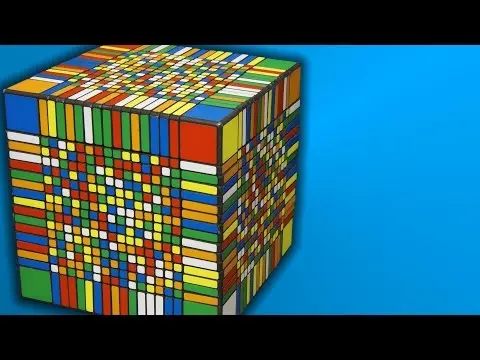
And if you have time to spare, you can also watch the full video, almost 8 hours long.
The record: a 33x33
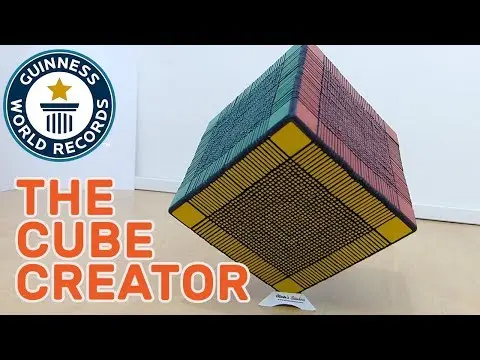
According to Guinness World Records, the biggest working cube in the world is a 33x33 built by Frenchman Grégoire Pfennig in 2017, after years of designing his own cubes. It has 6,153 moving pieces, weighs 3.15 kg and measures 20.5 cm on each side. He used 20 grams of glue just to stick on the stickers. The Guinness World Records team visited him in his workshop in Belfort:
The giant cubes you can actually buy are a bit smaller. The biggest one that is mass-produced is a 21x21 by MoYu, with about 2,700 pieces, which went on sale around 2020. There's also a 19x19 by ShengShou and a 17x17 by YuXin. They're expensive (the 21x21 costs well over a thousand dollars) and they aren't for everyday use: turning their layers takes patience and care.
Is it really more difficult?
The funny thing is that a big cube doesn't require a much more complicated method. Almost all of them are solved by "reduction":
- You complete the centers of each face (on a 17x17, each center has 225 stickers).
- You pair up the pieces of each edge until they form a single long edge.
- From there, the cube is solved like a 3x3, with the same steps.
Even cubes (4x4, 6x6…) also have some special cases, called "parities", that can't happen on a 3x3 and have their own move sequences. But the really hard part is not getting lost: you have to make thousands of moves without a mistake and without undoing what you've already done.
So if one day you want to take on a giant cube, the first step is to master the 3x3. Start with our step-by-step Rubik's Cube solution and, if you want something smaller to warm up, the 2x2 solution. And if you're looking for your next cube, on our buy puzzles page you'll find everything from the 2x2 to the 15x15.